Sep 24, 2018

Generating akka-http endpoints from protobuf declarations

When I started working with akka-http last winter I was surprised they had no better alternative to hand-crafting RESTful endpoints. The gRPC Gateway prototype inspired me to some experimentation. Back then I was still hoping to convince people at work to avoid REST. Recently I wanted to share what I had learned with a colleague and it pushed me to finish the first actually working version.

There are a couple interesting tidbits for protobuf connoisseurs in general. I picked them up while digging into the gateway project. To begin with, the protobuf specification has a description written in protobuf. It is important because the protoc compiler supports plugins which in turn operate in terms of those meta-level protobufs. So you don't have to start your protobuf transpiler from scratch. The ScalaPB project did all the hard work of integrating with protoc toolchain. I am still afraid of my SBT file which I had to mostly borrow.

Secondly, the protobuf specification defines a somewhat obscure feature known as extensions. GOOG itself used an extension to define a mapping of RESTful API elements onto protobuf declarations. It was a pleasant surprise to finally find a standard. You take a protobuf service declaration, augment it with an option clause following clear guidelines, and all of a sudden your still valid protobuf file can be a player in the RESTful world too.

All that remains is to walk an AST comprised of protobuf descriptor classes and generate some code.  On the one hand, it easier than writing a query parser. On the other hand dealing mostly with Strings feels less structured. The current approach was borrowed from the gateway project. I am unhappy with its structure but don't have a good enough alternative yet. Nevertheless the code is straightforward and can be extended.

In our case the generated code will be a skeleton of akka-http service. It starts with some boilerplate Akka initialization and then generates HTTP request processing directives. To illustrate the use of the code generator there is a small sample service project. It's pretty self-explanatory once you look at the protobuf file. 

I learned a few things from this PoC:

  • the protoc toolchain is not particularly nice to JVM-based code; thank God for ScalaPB but your SBT file will be rather cryptic anyway
  • now that we know how to write a scalac plugin the actual transpiler logic is quite easy to write
  • the protobuf-to-REST mapping is very reasonable but has edge cases such as nested messages
One point of contention is streaming. It's well known that gRPC streaming is not synonymous with bulk data transfer. The former operates on individual messages, the latter deals with sending a large file without buffering the entire file in a byte array. The former is represented by some ScalaPB-generated case classes, the latter typically looks like an akka-http Source. So there is no standard way to express in protobuf the need to generate anything akka-streaming-related.

Aug 28, 2018

Transactional saga in Scala IV

Part V : Mapping future

.. in which Japanese researchers and a mad Russian scientist continue

With a reasonable Scala implementation and its Java approximation the original problem was solved. What kept nagging me was a feeling that something "monadic" could be possible. Sagas are not new, a lot of functional idioms are about sequences. Surely some prior art must exist.

As luck would have it I found an interesting paper almost immediately. It was both very relevant (see "2.1 Atomic Action and Workflow") and accompanied by Scala code. Fundamentally the paper considers some advanced features but it starts from a key idea of applying the Continuation Monad to chaining saga transactions. The bad news is that the original code relies on scalaz and does not work with Futures.

At first I stared at the code in despair. Then I remembered that I happen to sit nine feet from a legit mad scientist who is really into FP. He got interested in my use case and graciously adapted the code to the problem at hand. Behold the monadic version:
If you are like me it'll take you a while to meditate on the simplified code above. First continuation machinery is defined, then a means of converting an action into a continuation is provided (notice the "a: => Future[A]" syntax), and finally our favorite saga is actually composed.

Now about that continuation monad. Apparently it is classical but not really discussed even in the red book. Enough people were confused at work about it that the very same scientist came up with a lengthy explanation. I couldn't recommend it enough. Also now I know that implementing a monad in Scala requires three methods that satisfy the monadic laws.

This post is unusual because I don't fully understand the stuff I am writing about. I am still trying to wrap my head around it. My lame excuse is that very few people at work are comfortable with this code. It has nice type safety and composability. For me writing the monadic wiring from scratch would be a stretch. Lots of intellectual stimulation but merging something like that into a real codebase is a very open question for me.

What is worse is that for those who are unprepared (empirically, the vast majority) the core of this code is unmaintainable, pretty much "write-only" incantations. Concurrency could be hard but one can always go read JCiP one more time. For this stuff there is no bible. As a matter of fact I know only one book that successfully tries to put FP into practical use but it's too basic anyway.

P.S.
Speaking of monads and scientists, if you are into akka-http go look at the pull request making Directives monadic. Personally I expected the Akka guys to be much more impressed.

Aug 14, 2018

Transactional saga in Java

Part IV : Intermezzo

.. in which we try and fail exceptionally to have Futures more complete

Having developed the third Scala version I got curious about doing the same in Java.  I more or less expected the CompletableFuture to be a more verbose flavor of the Scala Future. It had also been a year since I stopped writing Java and I wanted to check how I felt about it. If you remember the last Scala iteration the following should look familiar:


At first glance "thenCompose" is like "flatMap" and "exceptionally" resembles "recoverWith". Close but no cigar. You cannot return a CompletableFuture from a function taken by CF::exceptionally. It does not cancel the rest of saga execution either. Not even in JDK10. So I had to throw an exception and to manually roll back transactions the way it worked in the second Scala version. It's tolerable but not exactly elegant.

One lesson here is that Scala Futures are at least a little more powerful than the Java ones. Once you get used to monadic composition two dozen Java signatures do not look all that readable anymore. While typing Java code I also noticed how tedious it is in comparison with Scala. All trivial bits such as constructors, semicolons, and no variable type inference result in constant friction. I am afraid I don't feel like writing Java anymore.

Aug 10, 2018

Transactional saga in Scala III

Part III : Back to the Future

.. in which we return to a Futures-based design but this time compose them idiomatically

Now that a naive Future-based version is out it's time to make it look idiomatic in the third iteration.  I was thinking about composing Futures with flatMap. I did not know how to chain multiple transaction rollbasks though. What I learned in the code review was unexpected.

A colleague caught me by surprise by showing that in a chain of Futures a recoverWith clause is called not just for the Future that failed but also for all the preceding ones.
Another small difference is the nested exception class. The problem it solves is logging the transaction that failed. Without it every rolled back transaction would be logged. This cosmetic improvement doubles the size of the recoverWith body though. Without it this version looks really slick.

At this point I was happy with my pull request. But one thought spoiled the pleasure. We are dealing with a sequence of monadic abstractions. We use flatMap. Could there be some truly monadic approach to composing sagas? Yes, we are finally leaving common sense territory and going some controversial places.

Aug 9, 2018

Transactional saga in Scala II

Part II : Future Imperfect

.. in which Future-based signatures are introduced but the Futures are orchestrated naively 

Now that the problem is understood it's time to consider the second iteration. This time all transactions return Futures. It is very convenient from the perspective of building a reactive service.  Compensation actions still return Tries. Partially for the sake of simplicity, partially to reduce potential for additional errors in the error handling path. The whole saga is wrapped into a Promise to make possible for the client to wait for completion.
As you can see, the conversion to Futures was done rather literally. On the positive side, it's so imperative one can easily see how it works. On the other hand, it looks more like Java. Stay tuned for what I learned during the code review.

Aug 8, 2018

Transactional saga in Scala I

Part I : Tried But Not True

.. in which we come across a real-life problem, establish its context, and try a naive approach to set the stage for the following posts

Recently I faced a practical problem at work which resulted in four iterations of a promising idea. I found the process instructive enough to share some details with the world. Individual iterations could be not particularly interesting but it's relatively unusual to see a head-to-head comparison of this kind. In this and following posts I am going to embed only skeleton implementations from a gist. If you are interested in detail, please see the real code with tests. 

The problem I was working on was making an operation spanning HDFS and RDBMS transactional. Imagine a (micro)service dealing with file uploads. In a typical flow you first put a file into a temporary location, then register it in the DB, and at last move the file to its real location based on a version-like value returned by the DB. We've got three atomic transactions. They should either all succeed or the ones that have been executed by the time of a failure must be rolled back.

My first and, frankly, only idea was to use sagas. It sounds epic :) but it was not supposed to be about fancy CQRS frameworks. I was just looking for a clean way to compose a few basic Scala types such as Try or Future. Also notice that the entire operation is stateful - each transaction returns some values and usually uses the values produced by previously executed transactions. We'll refer to that sate as transaction context. We can represent the basic abstractions like that: 


  • TxContext represents shared state with type-safe access
  • ObjectStore represents operations with HDFS files; some of them return a Future because input could be an akka-stream Source, others take an array and so return a Try
  • ObjectCatalog represents operations with RDBMS rows


My first iteration was about sketching the general flow of a saga. To begin with there were individual transactions doing actual work. Then there was some looping machinery to execute them and support automatic rollback. 
The ObjectStoreTx trait represents a transaction that can be executed with a context or rolled back. The TryListSaga object implements a loop that executes transactions from a list sequentially and can trigger rollback in case of error.

One obvious problem that the code surfaced is very common in Scala if you mix APIs based on Futures and Tries. No only they do not compose easily but also "waiting on a Future" should happen only at the top level. I had to find a way to rely on Futures everywhere.

Apr 16, 2018

Spark Data Source V2 - core interactions

With the general idea of Spark Data Source API v2 understood, it's time to make another step towards working code. Quite some time ago I was experimenting with the original Data Source API. It's only natural to see how that idea would look after the major API overhaul. I make the same assumptions as before so it's more of a prototype illustrating key interactions. 

Write path


In the write path a new Dataset is created from a few data rows generated by the client. An application-specific Lucene document schema is used to mark which columns to index, store or both. The Dataset is repartitioned and each partition is stored as an independent Lucene index directory.


  • Client - creates a new Dataset from a set of rows; configures data source-specific properties (Lucene document schema and the root directory for all index partitions)
  • LuceneDataSourceV2 - plugs LuceneDataSourceV2Writer into the standard API
  • LuceneDataSourceV2Writer - creates a new LuceneDataWriterFactory; on commit saves the Lucene schema into a file common for all partitions; on rollback would be responsible for deleting created files
  • LuceneDataWriterFactory - is sent to worker nodes where is creates a LuceneDataWriter for every partition and configures it to use a dedicated directory
  • LuceneDataWriter - creates a new Lucene index in given directory and writes every partition Row to the index
  • LuceneIndexWriter - is responsible for building a Lucene index represented by a directory in the local file system; it's basically the same class as used in my old experiment

Read path


In the read path a previously created directory structure is parsed to find the Lucene schema and then load a Dataset partition from every subdirectory. Optionally, (A) the data schema is pruned to retrieve only requested columns and (B) supported filters are pushed to the Lucene engine to retrieve only matching rows.


  • Client - loads a previously written Dataset from a given root directory
  • LuceneDataSourceV2 - plugs LuceneDataSourceV2Reader into the standard API
  • LuceneDataSourceV2Reader - loads Lucene schema from the root directory, prunes it to align with the schema requested by Spark; in case of predicate pushdown, recognizes supported filter types and lets the Spark engine know; scans the root directory for partition subdirectories, creates LuceneReadTask for each
  • LuceneReadTask - is sent to worker nodes where it uses a LuceneIndexReader to read data Rows from the corresponding Lucene index
  • LuceneIndexReader - wraps Lucene index access; pushes the predicates chosen by the LuceneDataSourceV2Reader to the Lucene engine

The first impression is that the new API is actually an API. It has a clear structure and can be extended with additional functionality. We can already see exciting work happening in 2.4 master. 

Mar 28, 2018

Integrating AWS SDK v2 with Akka streams

It's been a while since I last used AWS S3 a lot. In the mean time AWS came up with a new SDK and I started working with Scala and Akka full time. The SDK is still in beta but it's hard to imagine it'll take them more than a few more months to finish. Akka is still convenient but choke-full of APIs at different levels of complexity. Among other things I am researching how some of them could play together nicely. While digging, invariably a nugget or two can be found.

I wanted to plug S3 file download functionality from the SDK into a code path based on Akka streams. The former is all about CompletableFutures, the latter is about Source/Sink abstractions wired together with mostly built-in stages. Both are relatively large and self-sufficient frameworks with their own thread pools and coding idioms. I found one easy way to make them work together.

The trick is to notice that the AsyncResponseHandler returns a reactive stream Publisher. Yes, a third famous API in a file of less than a hundred lines. Akka can create a Source form a Publisher. It was also an unusual opportunity to use a Scala Promise (a quick reminder - in Scala a Promise provides write access to the state represented by a Future for read access). The idea is
  • as is custom in Scala, a time consuming operation is wrapped into a Future
  • a Promise is created before a download operation is started
  • when the download operation is started, the Promise is used to create a Future that is returned to the client
  • when the download operation finishes, the Promise is completed successfully
  • there is also the error case where the Promise is used to convey the error to the client

A unit test illustrates how a created Akka Source can be used to actually transfer some data using built-in Akka file Sink. I use a small S3 file made publicly available by some kind strangers.  

My first impression from this exercise is that it is reasonable but feels a little unnatural. Yes, the code itself is quite concise and the performance penalty must be negligible. But the j.u.c ecosystem is mostly alien to idiomatic Scala.  

Jan 10, 2018

Adapting a gRPC service to REST with ScalaPB Gateway

Now that we have seen a Scala gRPC service and a Scala RESTful service it's only natural to wonder if there is any middle ground. You want to have a nice and performant backend but you could also  have a lot of RESTful legacy code or be really into curl. Your wish is my command.

The first piece of the puzzle is the fact that GOOG has a standard for mapping REST APIs onto protobuf declarations. With no hacks or any hard thinking you can augment your existing proto files to be REST-friendly.

The second piece is making use of such a mapping. Apparently there is a Go implementation of what is known as gRPC Gateway. It can work with any gRPC service and so could be used with the ones implemented in Scala. But there is another, arguably more appealing option. The ScalaPB library we met before can generate a Scala RESTful gateway too. I guess it's not as well tested or supported but then again there is not that much code behind it to prevent it from serious use.

So I went ahead and updated my two-service gRPC example to support ScalaPB REST Gateway generation. It intentionally borrows a lot from the pure gRPC example so that the difference can be easily seen by comparing files. Technically, you still need exactly the same gRPC service implementation as before. The proto files are almost the same.

There are two new objects. To begin with we need a new abstraction to wire together the generated Gateway code. It's essentially a gRPC client with hooks to plug the RESTful stuff into it. The other is just a typical HTTP client. I followed the path of least resistance and used Jackson for JSON marshaling and commons-http for sending requests. There is a little wiring but in general the code speaks for itself.

What I learned from this exercise is that making gRPC co-exist with REST is easy. I am not sure if running a Gateway locally for each service instance is a better idea than creating a single API Gateway service to front the rest of the backend.

As a parting note, I am surprised there is no other IDL for describing RESTful services for the purpose of code generation. With a standard AST and parser library it would be quite strait forward to generate REST endpoints for any popular service framework. It's equally surprising that the Akka team does not have a generator for akka-http endpoint from protobuf declarations. It looks like such a natural step for them and the ScalaPB project even has the foundation in place.

Jan 9, 2018

Asynchronous RPC server with Akka HTTP

At work my team maintains a number of RESTful services. The good news is that they are implemented with akka-http which makes things tolerable. The bad news is that it's all about REST and JSON. So we are having a lively debate about a possible migration to something more like gRPC.

Personally, I am not a fan of non-binary protocols and data formats. At least partially it is related to my experience in building analytics systems where any query routinely requires a lot of data. Yes, for the time being you have to use REST/JSON to communicate between the browser and your API Gateway. But using the same approach to make your backend services talk to each other never made sense to me. I am really looking forward to the day when WASM/HTTP2&Co finally make front end development great again.

In the mean time I would like to see if I can gather enough evidence in favor of my position. So in the spirit of my recent gRPC experiment I am going to implement basically the same API with REST. As a bonus, I want to mention a couple of observations I made using akka-http. As usual, the code is on github. I continue the tradition of implementing a service with two endpoints. I even mostly follow the same code structure as before with gRPC.


The picture above sketches high-level interactions. There are a few noteworthy Akka-related details inside but nobody will be surprised by another RESTful service implementation.
  • TestServiceA - is where the actual logic would be. It also hosts a trait and case classes which would be generated from a protobuf file in case of gRPC
  • HttpEndpointA - an actual HTTP endpoint that plugs service logic into HTTP network endpoint. A good example of Akka HTTP expressiveness.
  • AkkaHttpServer - the service implementation entry point. In typical Scala fashion it directly implements the main method and performs basic Akka dependency wiring. It is also responsible for binding request handlers to the underlying HTTP server.
  • Http - technically an object in a high-level Akka API it represents the usual functionality of request/response-style interactions over HTTP 
  • AkkaHttpClient - not shown; wraps akka-http-based client logic. I spent some time getting it right because client-side examples are harder to find. In particular it illustrates how to use Spray JSON marshaller. But it could be any HTTP client capable of sending a POST request with a JSON body. 
If you are curious enough to look at the code I would like to highlight a few details useful in real life. Not all of them are prominent enough in usual examples. The HttpEndpointA class would be a good illustration of most of them.
  • ExceptionHandler - you can configure a handler for exceptions uncaught otherwise. It is the last line of defense against unexpected problems. 
  • RejectionHandler - such a handler is very useful if you want to explicitly deal with invalid requests (e.g. garbled JSON or more likely a JSON body representing a request to some other service)
  • request timeout - even though Akka has a default global property ("akka.http.server.request-timeout") you could configure it explicitly for a service that is expected to take an unusually long time 
  • implicit JSON (de)serialization with Spray - it's very convenient to use but rather puzzling initially to configure. In addition to the marshaller object holding implicit vals notice how the "import ServiceAJsonMarshaller" statement makes it usable by "as" and "complete" directives
  • composing multiple Routes - different styles are possible here; if there were another URL to support in this endpoint we could (a) declare another "def process2: Route" and then compose the two with "process ~ process2" using another somewhat cryptic Akka directive
On the client side there are a few more details to mention. My first reaction was that Akka HTTP client code looks somehow less straitforward than what one would see with, say, commons-http. Any HTTP client would work for this example but I wanted to see one with akka-http to better grok the API.
  • JSON marshalling with Spray was a puzzle again. It was not clear to me from the official documentation but googling helped.
  • Somewhat unusually, the client requires the same ActorSystem and Materializer infrastructure as the server. 
My conclusion is that if circumstances force me to implement anything RESTful I will reach for Akka HTTP first. But in comparison with real RPC it's more work to produce less safe code. But that's a topic for another day.

Jan 1, 2018

gRPC in Scala with ScalaPB

Curiously enough my old post on gRPC still gets disproportionately many hits. Now that I work with Scala full time I was curious to see how my old Java example would compare with a Scala version. Spoiler alert: I don't have that much new to report. Other people covered it better before. This post probably makes more sense as a head-to-head comparison between Java and Scala versions.

From what I see Scala people tend to avoid Java libraries. I am skeptical it's a good idea especially around networking and concurrency where the Java ecosystem is at its best. But I am still learning and have no strong opinions developed yet. After all, last time I used Java j.u.c Futures, Guava Futures, and CompletableFutures were still all in the game.

In case of gRPC the unofficial Scala code generator is known as ScalaPB. Once you configure it in your SBT project it feels as natural as the official Java version. The good news is that the generated code operates in terms of Scala Futures and so feels idiomatic. But you still need to initialize the gRPC foundation and that part looks almost the same as in Java.

As before, the goal is to support two different service endpoints on the same server and to have fully asynchronous client and server implementations. As we concentrate on the request/response approach we completely ignore the question of streaming. gRPC bootstrap code is so simple that I could not find enough of it to extract anything truly generic. So even though I notionally have a server and a client they just wrap initialization logic and might be unnecessary.

There are a couple technicalities I would like to highlight:
  • I had to google and experiment to find out how to configure ScalaPB for a multi-module project and a non-default proto file directory
  • even though your actual logic is all about Futures and so requires ExecutionContexts, it's easier to start with an Executor to name threads and configure underlying thread pools and then wrap it into a context
  • I can think of a few slightly different ways to propagate ExecutionContexts; implicit vals are idiomatic but seem to be less readable despite saving a little typing
All in all, using ScalaPB feels a little more idiomatic but not that different from how it's done in Java.

Dec 11, 2017

Spark Data Source API V2 - write query planning and execution

Before you can read anything you need to have it written in the first place. The previously considered read path is a little simpler but certainly shares a lot with the write path we'll delve into today. Initially I am going to concentrate on the basic flow and ignore predicate push-down and column pruning. As my running example I assume a trivial Spark expression that uses some existing Dataset such as "df.write.format("someDSV2").option("path", hdfsDir).save()".

A data source is represented in a logical plan by WriteToDataSourceV2 instance created by data frame writer. During planning DataSourceV2Strategy transforms the relation into a WriteToDataSourceV2Exec instance. The latter uses the Spark context to execute the plan associated with the Dataset. The resultant RDD determines the number of input partitions and so the number of required write tasks. In addition, WriteToDataSourceV2Exec helps with keeping track of WriterCommitMessages used to make writing data source partitions transactional.

Query planning


In this phase the goal is to create a WriteToDataSourceV2 from a Dataset and client-supplied options and then transform it into a WriteToDataSourceV2Exec. The process is initiated by saving a Dataset. It triggers both logical and physical planning stages.


  • DataFrameWriter searches for an implementation of the DataSourceV2 marker interface. The implementation is expected to also implement the WriteSupport mixin interface that is the actual entry point into writing functionality
  • WriteSupport is a factory of DataSourceV2Writer instances
  • DataSourceV2Writer can create a DataWriterFactory and is ultimately responsible for committing or rolling back write partition tasks
  • WriteToDataSourceV2 is the logical plan node that represents a data source
  • A QueryExecution is associated with the WriteToDataSourceV2 to help with coordination of query planning
  • SparkPlanner uses DataSourceV2Strategy to transform logical plan nodes into physical ones
  • DataSourceV2Strategy recognizes data source logical nodes and transforms them into physical ones
  • WriteToDataSourceV2 carries a DataSourceV2Writer and logical plan associated with the Dataset; both are given to WriteToDataSourceV2Exec
  • WriteToDataSourceV2Exec is the physical plan node that represents a data source

Query execution - Driver side


In this phase the goal is to obtain data partitions from the RDD associated with the Dataset and trigger execution of a write task for each partition. In this section we look at the Driver-side half of the process.


  • WriteToDataSourceV2Exec creates a DataWriterFactory and a write task for each partition
  • The Spark context executes the tasks on worker nodes and collects WriteCommitMessages from successfully finished ones 
  • WriteToDataSourceV2Exec uses DataSourceV2Writer to commit or rollback the write transaction using collected WriteCommitMessages

Query execution - Executor side


The second half of the execution phase takes place on the Executor side. 


  • DataWriterFactory is serialized to worker nodes where DataWritingSparkTask are executed
  • Executor provides a DataWritingSparkTask with a Row iterator and a partition index
  • The task acquires a DataWriter from the DataWriterFactory and writes all partition Rows with the DataWriter
  • The task calls the DataWriter to commit writing and propagates a WriteCommitMessage to the driver

Dec 7, 2017

Spark Data Source API V2 - read query planning and execution

Without much marketing noise the Spark team decided to dramatically overhaul the current data connector API in v2.3 The new version was quietly merged into master recently. In comparison with the original approach the new one definitely looks like a real API. Even though nobody will be surprised by further evolution of the version one can see in master it already looks irresistibly promising. So I decided to spend some time digging into it. 

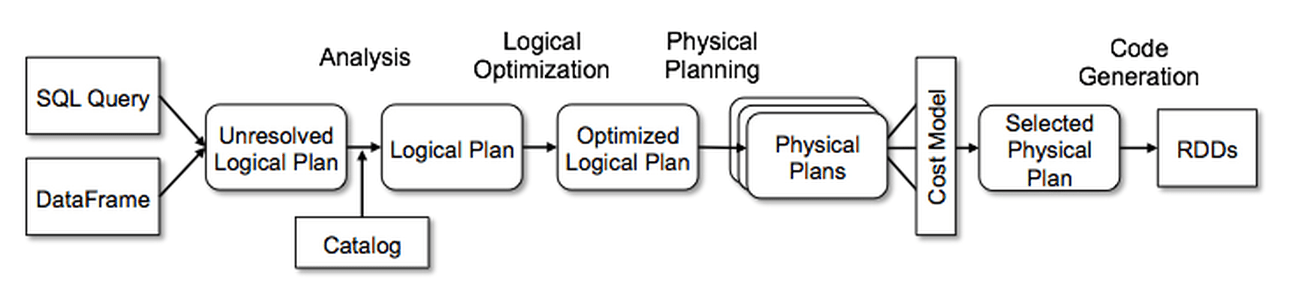
You probably remember the high-level architecture of the Spark query compilation process. It follows the traditional DBMS approach of parsing a query into a logical plan, optimizing the logical plan into a physical plan, and executing the physical plan on worker nodes. I am going to structure my investigation along similar lines.

https://databricks.com/blog/2015/04/13/deep-dive-into-spark-sqls-catalyst-optimizer.html

The following discussion does not shy away from relevant Spark query execution internals. Those are always fascinating even when not directly actionable. Moreover, the Data Source API implementation is a nice vertical slice of the generic Spark infrastructure. So this is a convenient opportunity to refresh my memory. I will omit fine details of the Spark internals in an attempt to highlight the big picture.

As my running example I assume a trivial Spark expression such as "SparkSession.read.format("someDSV2").load.count()".

Query plans and Data Sources in a 100 words or less


Logical and physical plan nodes are subtypes of the QueryPlan. Spark Planner is responsible for transforming a logical plan tree into a physical one. The planner relies on a configurable set of strategies for actual transformation rules.

A data source is represented in a logical plan by DataSourceV2Relation instance created by data frame reader. During planning DataSourceV2Strategy transforms the relation into a DataSourceV2ScanExec instance. The latter creates a DataSourceRDD instance that is used to actually compute the results in parallel from multiple partitions.

Logical query planning


In this phase the goal is to create a DataSourceV2Relation from client-supplied options. The process is initiated by loading a Dataset.

  • DataFrameReader searches for an implementation of the DataSourceV2 marker interface. The implementation is expected to also implement one of ReadSupport mixin interfaces that allow the engine to know optional capabilities of the data source
  • ReadSupport is a factory of DataSourceV2Reader instances
  • DataSourceV2Reader knows the data source schema and can create ReadTasks
  • DataSourceV2Relation is the logical plan node that represents a data source
  • Dataset owns a QueryExecution and is associated with the DataSourceV2Relation

Physical query planning


In this phase the goal is to transform a DataSourceV2Relation into a DataSourceV2ScanExec. The process is initiated by executing an action on the Dataset created by the previous phase.


  • Dataset owns a QueryExecution
  • QueryExecution coordinates query planning
  • SparkPlanner uses DataSourceV2Strategy to transform logical plan nodes into physical ones
  • DataSourceV2Strategy recognizes data source logical nodes and transforms them into physical ones
  • DataSourceV2Relation carries a DataSourceV2Reader that is given to DataSourceV2ScanExec
  • DataSourceV2ScanExec is the physical plan node that represents a data source

Query execution


In this phase the goal is to obtain data partitions from the RDD created by  DataSourceV2ScanExec and collect data Rows from all the partitions.

  • DataSourceV2ScanExec creates ReadTasks using its DataSourceV2Reader and converts the tasks into a DataSourceRDD
  • DataSourceRDD wraps each task into a DataSourceRDDPartition that knows its id
  • ReadTask represents a single data partition. A ReadTask is serialized and sent to a Spark worker.
  • After DataSourceRDD execution is triggered, on executor side the DataSourceRDD obtains a DataReader from the ReadTask
  • DataReader is an iterator of Rows from one data partition  


Nov 29, 2017

Parquet file query DSL with FastParse

A year after my last foray into DSL parsers I find myself working with Scala full time. My first impression is that Scala folks like re-implementing things from scratch despite easy access to the first-class Java library ecosystem. With the standard Scala library having surprisingly high for a mature language turnover (e.g. see original Actor library replaced with AKKA, very inefficient original parser combinators, Scala Collections overhaul, Monix tasks trying to catch up with CompletableFutures) I am not entirely convinced it's always justified.

Nevertheless it could be helpful to be able to see the same DSL grammar implemented using another modern parser library. FastParse seems to be the current favorite. While trying to wrap my head around it I went back to the original grammar and ported it to FastParse. There is not that much to see because the actual parser is a single class of fewer than 100 LoC. I implemented it mostly following the example of Parboiled-based parser but it also has family resemblance with ANTLR grammar.

Among my first impressions:
  • FastParse version is the smallest in LoC (with a factor of 1.5-2)
  • FastParse can easily express basic lexer rules that I had to experiment with harder in ANTLR 
  • it takes effort (and copy-pasting from examples) to deal with FastParse "grammar" code. Overloaded Scala operators are reasonable and even convenient but their non-standard nature requires some getting used to
  • there is no need for additional MVN/SBT plugins
  • Scala itself is the largest transitive dependency, FastParse is a couple of JARs of under 400K
  • FastParse generates reasonable traces for debugging 
  • it's very easy to enable case-insensitivity though it adds noise to the parser
  • it's very easy to automatically skip whitespaces though the syntax for doing it looks odd
  • map-based syntax for building custom AST nodes is pleasant
  • online documentation is quite extensive and includes a couple large-scale parsers
  • you can use FastParse from Java; I did it to re-use my tests written for last year's parsers

In general I definitely like FastParse more than Parboiled. This comparison is somewhat unfair because in comparison with Java any Scala code is more terse. I would go as far as to say that for tiny DSLs FastParse should be the default choice. For a large grammar readability, visual tools, and likely performance of ANTLR are still as important as ever.


Sep 7, 2017

Tantalizing promise of GPU for analytics workload

For the last few years the trend in analytics systems has been to implement traditional MPP-style architecture as an open source, usually JVM-based product. Impala was the only exception. Surprisingly, its C++/LLVM foundation did not make it the leader of the "SQL on Hadoop" space which is probably a testament to modern Java performance. 

More recently, everyone began converging on the triad of columnar storage (off-heap when in-memory), vectorized operators, and operator byte code generation. Parquet / Arrow-style columnar format helps with compression and reducing disk-to-memory data transfer volume. Vectorization can take advantage of SIMD (e.g. see Lecture #21 - Vectorized Execution) or at the very least alleviate CPU cache line thrashing. 

By v2.0, Spark had covered most of the ground. It's interesting to note that even though cached dataframes are stored in  a compressed columnar format, physical operators are still not vectorized and so process a row at a time (e.g. see a rare glimpse of the internal machinery in the design doc attached to SPARK-14098 "Generate Java code to build CachedColumnarBatch"). 

Judging from SPARK-15687 "Columnar execution engine", the need for vectorized operators vis-a-vis whole stage code generation seems to be a topic to seariously debate this year. Nevertheless it would still be a well understood approach other features such as SPARK-19489 "Stable serialization format" could benefit from.

What is easy to miss behind all this progress is that the GPU revolution ignited by DL/ML quietly arrived to the analytics world too. My high-level understanding of the GPU is essentially "very fast operations on columnar data once you copy it from main memory to the GPU". Which almost looks like very advanced SIMD with high latency. So my initial expectation was that analytics queries would not be much faster because of the sheer data volume required by an average query.

I was clearly wrong. My favorite source of query engine benchmarking statistics shows that MapD and Brytlyt score very high. Both were designed from ground up for the GPU. One challenge with GPU-related technology is that it's way too low-level in comparison with any JVM-based development. 

So most people will probably end up just learning the big picture. For a reasonable overview of GPU usage in the OLAP context, I would recommend the Red Fox research project and their "Red Fox: An Execution Environment for Relational Query Processing on GPUs" paper in particular.

To the best of my knowledge, this topic is of limited interest for Spark project currently. At least partially because it would take columnar data formats and vectorized operators to align Spark internals with GPU coding idioms and data layouts. It probably makes sense to keep an eye SPARK-12620 "Proposal of GPU exploitation for Spark" and whatever else its author does even if that prototype did not succeed.

Apr 20, 2017

Rules of three in software development

Most people agree that software development is a craft. As such, it accumulated heuristics and rules of thumb that are hard to prove in any remotely scientific way. But see enough code bases over a few years and certain patterns will certainly look plausible. I would like to ponder a couple of representative examples that struck a chord with me.

Make it work, make it work right, make it work fast


I believe this saying originated in the heydays of the OO. You could probably interpret it as "building a vertical slice of the system" in RUP or "YAGNI and iterations" in Agile. If you squint enough even MVP-centered thinking common in startups could be another reincarnation of the same principle.

In practical terms it boils down to:
  • find a small use-case, choose OSS libraries that can help implement it quickly, prepare project infrastructure (e.g. build system, code tree structure), write the code, produce something small but runnable and call it a prototype
  • once you acquire basic experience with new technologies and have your prototype to share with other people you are ready to have a meaningful technical discussion with them; if all goes well, extend the prototype into an MVP that could be deployed to production
  • once you have a basic version running in production, start working on a second major release that can improve scalability and stability

My last experience with this flow was with Spark and Parquet. In mid-2015 I prototyped a few basic ideas such as exporting data from our system as Parquet files and running Spark locally to work with Parquet files. I made a few observations about small details not discussed in the documentation. So when ideas for a new ETL pipeline were discussed I could show actual code examples closely related to our particular needs.

Once we could show some numbers from running the prototype in Spring 2016 other people were comfortable with making an architectural decision. By Fall 2016 we had an MVP that could do most of what the legacy code was capable of. While migration to the new pipeline started in production in late Fall, we could switch attention to the second major release which addressed stability issues and applied data storage optimizations.

OSS/3d party, low-level API, less generic in-house implementation 


Another evolution I see frequently goes like that:
  • Come up with big ideas for a new service
  • Quickly develop a prototype using an OSS product that implements some of the big ideas
  • In case of encouraging performance test results, finish the MVP and go to production
  • Once initial performance gets insufficient, start digging into the OSS code and documentation is search for obscure lower-level APIs; replace usage of simple and easy APIs with more efficient but cumbersome ones
  • Once you understand your system trade-offs and data access patterns consider having your own, less generic but more optimized for your circumstances replacement for the initially used OSS component  
A recent example would be solving the challenge of data retrieval for interactive analytics. Postgres was not fast enough anymore. The big idea was to use search engine-style approaches such as fast bitmap indices. The obvious OSS candidate was Lucene. We used a less popular but still high-level API with additional optimizations added later. 

Once we had it in production the urgency subsided and we had time to recognize some context-specific assumptions about our data we could make. The second major release dived much deeper into Lucene internals and resulted in a few customizations built to take advantage of what we found. At some point in the future the next step could be going the same way as Druid did - replacing Lucene altogether with an in-house implementation of the inverted index.

Three kinds of developers


By the virtue of being a human issue and not just a technical question this example is harder to discuss. As a matter of fact, there is a beautiful post that you should read even if you ignore the rest of that highly recommended blog. 

There is no question that both individual psychology and level of experience play a huge role in this. Unfortunately all I can imagine to be actionable about it is to try to be self-aware enough to see those patterns in yourself and your teammates. 

It might be also the case that if you are a settler you will not like A-round companies because of all the chaos, poor engineering, and one-man components. Conversely, a pioneer might feel strange after a B round when a larger team starts building real technology and team communications and documentation needs grow in importance.

Probably because of the time I spent in B-round startups I believe I have seen more pioneers and settlers than town planners. The latter are probably those mythical "enterprise developers" frequently mentioned on HackerNews. 

Jan 30, 2017

Compressing time series with Gorilla in Java

You might know FB for their censorship efforts and spying on the users but did you know they also write software? :) In a two-year old paper they discuss a very insightful and practical approach to compressing time series. Better yet, they even have an OSS implementation. Though C++ is not hard to read, it makes the original code not that useful in the JVM land. 

First, a brief recap of the compression ideas:
  • The data model is a sequence of (timestamp:int64, value:double) pairs. They split a sequence into blocks aligned with two-hour windows but we'll ignore such higher-level concerns.
  • Timestamps and values are compressed separately. 
  • Timestamps are stored as the first timestamp value followed by variable-length encoded delta of deltas. Four value ranges are supported ([-63:64] , [-255:256], [-2047:2048], "fits into 32 bits").
  • Values are stored as a sequence of the first value followed by variable-length encoded values produced by XOR-ing next value with the previous one. The binary representation of an XOR-ed value is split into "leading zeros", "block value", and "trailing zeroes" parts. The numbers of leading and trailing zeroes are stored as bytes.

I wanted to see how well Gorilla compression can cope with less predictable data. The kind of time series I am interested in is not as periodic as IoT data. So I ended up porting a couple of classes to Java. The time series class can be used for writing data or reading it but not both simultaneously. 

The current implementation is intended to help with testing compression quality and does not necessarily support other uses. The unit test shows how to read a compressed time series. The only catch is that reading the first timestamp requires a dedicated method call while all the values can be read calling the same method.

Dec 27, 2016

Parquet file query DSL with ANTLR

Last time on Sheldon Cooper presents fun with flags we saw a lightweight alternative to ANTLR used to parse a simple query DSL. I was having too much trouble with another alternative so in the meantime I decided to finish a proper ANTLR version of the parser. As luck would have it, in ANTLR4 there is more than one way to write a parser. So for a low, low price of a single grammar file you get a parser written in the officially recommended way and the other following a more traditional approach.

Strictly speaking, there are two grammar files but if you squint a little you can see one was created by adding actions to a copy of the other. ANTLR4 makes an attempt to avoid actions in a grammar file to simplify the file and make possible parser generation in languages other than Java. 

Instead of actions one can implement a parse tree listener interface. The good news is that it indeed allows better isolation between grammars and Java code. The bad news is that there is even more choice if you want to do something that requires sharing state between parser rules. Like building an AST.

Of the two simplest choices, I decided to use a manually maintained stack. It could probably be done with a visitor implementation returning AST nodes but the listener with a stack approach makes the juxtaposition with Parboiled even better. A new trick in ANTLR4 is using "# Something" snippets in the grammar to make ANTLR generate a listener method for every rule alternative. 

The listener ended up looking more similar to the Parboiled parser than I had expected. That made me think about trying the traditional approach with actions embedded into grammar. At first glance, the listener approach looks cleaner indeed at no discernible cost.

ANTLR is still very good with skipping white spaces at the lexer level. No need to contaminate the parser rules with redundant checks everywhere. But to my surprise I actually found a couple other problems. To begin with, there is no easy way to make keywords case-insensitive. Secondly, I failed to write a parser rule that would return "unquoted" string values without breaking the ID lexer rule. I am probably not the only one confused with the latter. After some experimentation I simply settled on manually calling String::substring.

In addition to two spectacular books there is a lot of online documentation as well. The ANTLR maven plugin works seamlessly with no additional configuration so the gossip of "additional build process step" is widely exaggerated. 

Between an easier to read grammar file and very powerful IDE integration ANTLR remains the leader. But from what I see the code size and complexity are roughly the same as for Parboiled. There seems to be the only 300K ANTLR runtime library. Parboiled has half a dozen dependencies (mostly ASM jars) of comparable total size.

So as a provisional conclusion, I don't feel strongly anymore that ANTLR is the only right answer to parsing needs in Java. I should probably run a performance test at some point but I doubt +-20ms is of real concern to most small DSLs consumers.

Dec 24, 2016

Parquet file query DSL with parboiled

Now that we know how to push down Parquet predicates the next logical step is to come up with a DSL to make writing predicates easier. The DSL would be handy for debugging, especially if it can be implemented with few additional dependencies. Running Spark just to have access to Dataset query syntax is not always convenient.

What I have in mind is something very straightforward, after all there is little else to express than predicates. It could be as simple as "SELECT * FROM '/tmp/somefile.par' WHERE ('column1'=42) || ('column2'=24)" to filter a file by a couple of columns.

http://mshang.ca/syntree/?i=%5BQUERY%20%5BSELECT%20123%2C456%5D%20%5BFROM%20%2Ftmp%2Ffile.par%5D%20%5BWHERE%20%5B%26%26%20%5B%3D%5B'col1'%5D%20%5B33%5D%5D%20%5B%7C%7C%20%5B%3D%5B'col2'%5D%20%5B42%5D%5D%20%5B%3D%5B'col2'%5D%20%5B24%5D%5D%5D%5D%5D%5D

When I think about query parsers ANTLR is the default choice. Its functionality, stability, and documentation are outstanding. But the syntax I mentioned makes me think that a lighter approach could be possible. So to a significant degree this exercise will be an attempt to compare a few parser libraries in the context of very small DSLs.

I decided to start with a heterogeneous AST representation and the pseudo-SQL syntax I mentioned above. To evaluate the alternatives I am going to pay attention to:
  • parser-related code size, complexity
  • grammar readability
  • transitive dependencies brought by the parser library
  • build process changes required (e.g. maven plugins)
  • tool chain, support for debugging of parser errors

Today's contender is Parboiled and its Java library in particular. The actual parser for my DSL is a reasonably small class. Syntactically, the PEG rules look quite isomorphic to how I imagine the corresponding CFG. The library provides a built-in stack that is very helpful for building AST nodes. When the stack is not enough, one can also use action variables that allow collecting results from other rules. 

Parboiled wiki provides a lot of useful information and in addition there are a few nice parser examples. Parboiled is a pure Java library so there is no need for additional maven plugins. It has just a few ASM dependencies. As for debugging, I found the tracing parser very convenient. 

Coding-wise, it took me some time to get used to calling "push/pop" as the last Rule in a Sequence. I also started with too many action variables but was able to covert most of them to operations on the stack. 

One minor problem with Parboiled is the lack of easy means of skipping white spaces in the tokenizer. I am pretty sure my current parser can be broken by adding space characters to a query here and there. Guarding every Sequence with a white space consuming rule seems to be the only viable approach.

Nov 15, 2016

Parquet file filtering with predicate pushdown

As I discussed before, Parquet file format is extremely well suited for storing data in analytics systems because of its columnar approach. But it gets better (even after you take into account column data compression). Parquet library supports predicate push-down which makes it very complimentary to Spark-like analytics query engines. Depending on your data model and data distribution it could be possible to skip entire blocks when reading a Parquet file.

The Filter API supports predicates that can use usual comparison operators on column field values. Individual predicates can be composed using logical AND and OR operators. In addition, user-defined predicates are supported. They can skip an entire file block if the column metadata indicates that the block has no matching values.

The Filter API is comprised of just a few abstractions:
  • FilterCompat.Filter - the push-down predicate interface taken by ParquetReader builder as an optional parameter
  • FilterApi - builder methods that create individual predicates and compose them together 
  • UserDefinedPredicate - the interface to be implemented by user-defined filters; it supports block-level predicates in addition to usual record-level ones

I updated my Parquet example to demonstrate usage of a disjunctive filter and a user-defined one. At a high-level:

  • FilterApi is repeatedly called to resolve a column name into a column reference, create individual predicates using the reference, and compose predicates
  • Behind the scene, a tree of inner Operators class instances is created
  • FilterCompat facade is called to wrap the tree into Filter implementation recognized by Parquet file reader
  • A new file reader is created using the Filter
  • Internally, different visitor types are used to apply record-level and block-level predicates